news
27.01.2026
How I Landed My First Developer Job in Japan Without a Traditional Resume
How developers can land jobs in Japan without a traditional resume by using a portfolio-first strategy, networking, and strong online presence.

Introduction
- Relatable hook: “How can I get hired when Japanese companies still ask for a detailed 履歴書 and shokumu keirekisho?”
- Main question/problem: Is it possible to secure a developer role in Japan without the standard resume / CV path?
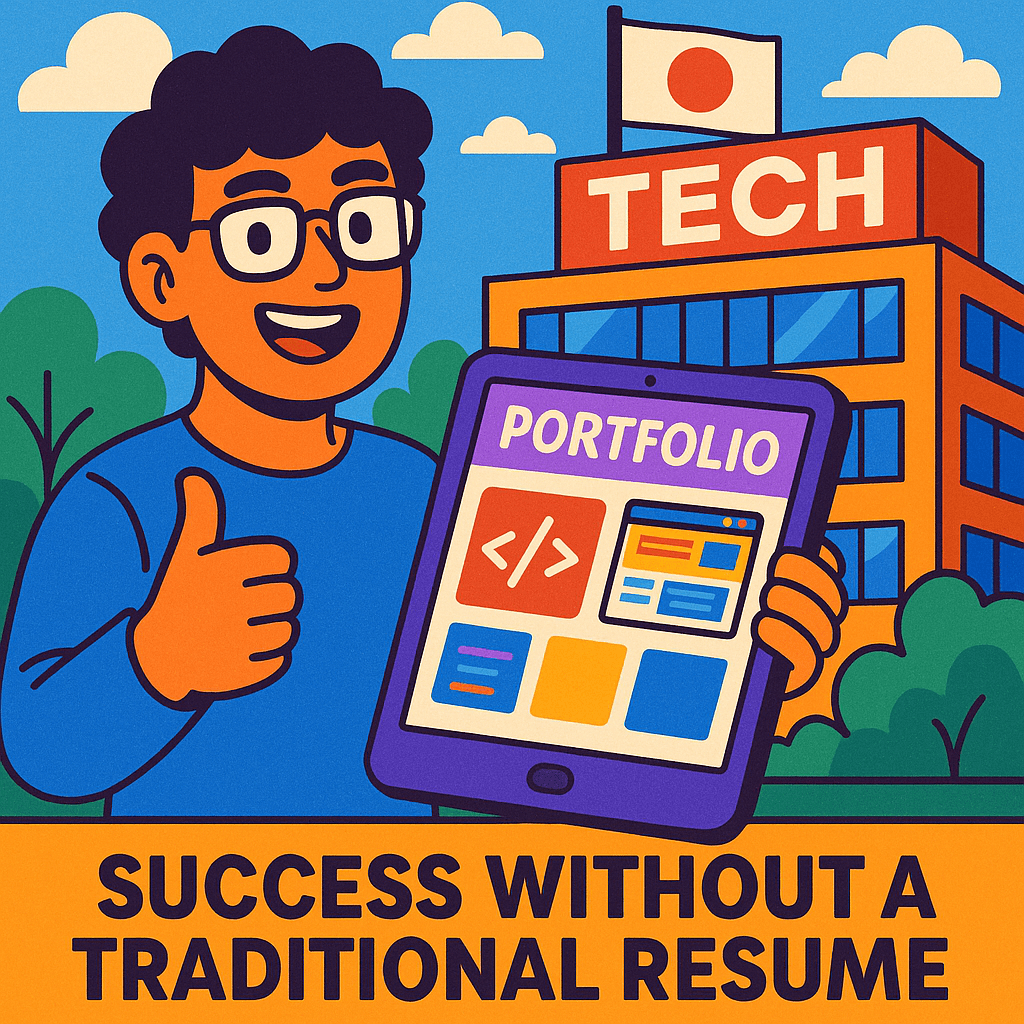
- Promise: I’ll share how a portfolio‑first approach, networking and online presence can open doors in Japan’s tech scene.
- Table of contents: What is a portfolio‑first strategy? • Core steps to implement it • Portfolio vs traditional resume • Special cases (e.g., career changers) • Related avenues (open‑source, contests) • Junior vs mid‑career applicants • Tips & best practices • Conclusion
What Is a Portfolio‑First Job‑Search Strategy?
- Definition: A job‑search approach that prioritises showcasing real projects (GitHub, public apps, freelance work) over a formal resume.
- Background/context: Traditional Japanese hiring emphasises resumes and work history; tech employers increasingly value demonstrable skills.
- Categories/subtypes: Public GitHub repositories, live demo sites, contributions to open‑source.
- Examples: A web developer’s personal website with project case studies; a mobile app published on the App Store.
Main Answer / Core Information
- Direct answer: Yes—many Japanese tech employers are open to portfolio‑driven applicants if the work clearly demonstrates skills and problem‑solving.
- Variations/types: Full portfolio (projects, blog posts, code samples); hybrid approach (resume plus portfolio); online brand (LinkedIn + Twitter + tech blog).
- Examples/data: List of interview invites from companies that came after sharing a project on Reddit; examples of portfolios that earned interviews.
Portfolio‑First vs Traditional Resume
Portfolio‑First
- Pros: Demonstrates actual abilities; stands out in a competitive market; circumvents rigid template requirements.
- Cons: Requires time to build and maintain; may be undervalued by conservative HR departments.
- Best for: Self‑taught coders, bootcamp graduates, career changers.
Traditional Resume
- Pros: Familiar format for Japanese HR; easy to scan; emphasises formal education and employment history.
- Cons: Difficult for newcomers with little local experience; risks being filtered out automatically.
- Best for: Candidates with relevant work history and Japanese résumé translation ready.
Special Cases / Subtopics
- Scenario: Switching careers from non‑tech fields. Guidance includes building small apps in your new field (e.g. teacher builds a class management tool) and highlighting transferable skills.
- Tools/resources: GitHub, Netlify, Qiita blog posts in Japanese to show commitment.
Related or Niche Category
- Definition: Open‑source contributions as a proof of skill.
- Differences: Community‑driven code vs personal portfolio; shows collaboration skills.
- Process: Find beginner‑friendly issues, contribute, document your work.
- Where to find it: GitHub “good first issue,” open‑source Slack groups, Tokyo OSS meetups.
Beginner vs Experienced Job Seekers
- Cost/effort comparison: Beginners invest more time in foundational projects; experienced developers can highlight production code.
- Quality comparison: Senior portfolios show scalability and testing; junior portfolios focus on learning progress.
- Who should choose each: Newcomers emphasise learning journeys; experienced devs emphasise architecture and leadership.
Tips & Best Practices
- Keep projects focused and documented in English and Japanese.
- Write project summaries explaining your role and the technologies used.
- Include tests and CI/CD to signal professionalism.
- Avoid overcomplicated designs; clarity wins.
Conclusion
Building a portfolio‑first presence can bypass some of the barriers of traditional Japanese recruitment. By demonstrating real skills and persistence, you can attract employers who value ability over format—turning “lack of a résumé” into a unique strength.
Subscribe to Newletter
Subscribe to Newletter