tech
27.01.2026
Your First Tech Job in Japan: A Practical Roadmap for 2026
A 2026 step-by-step roadmap to land a tech job in Japan—skills, visas, interviews, salaries, and relocation, even with zero Japanese.

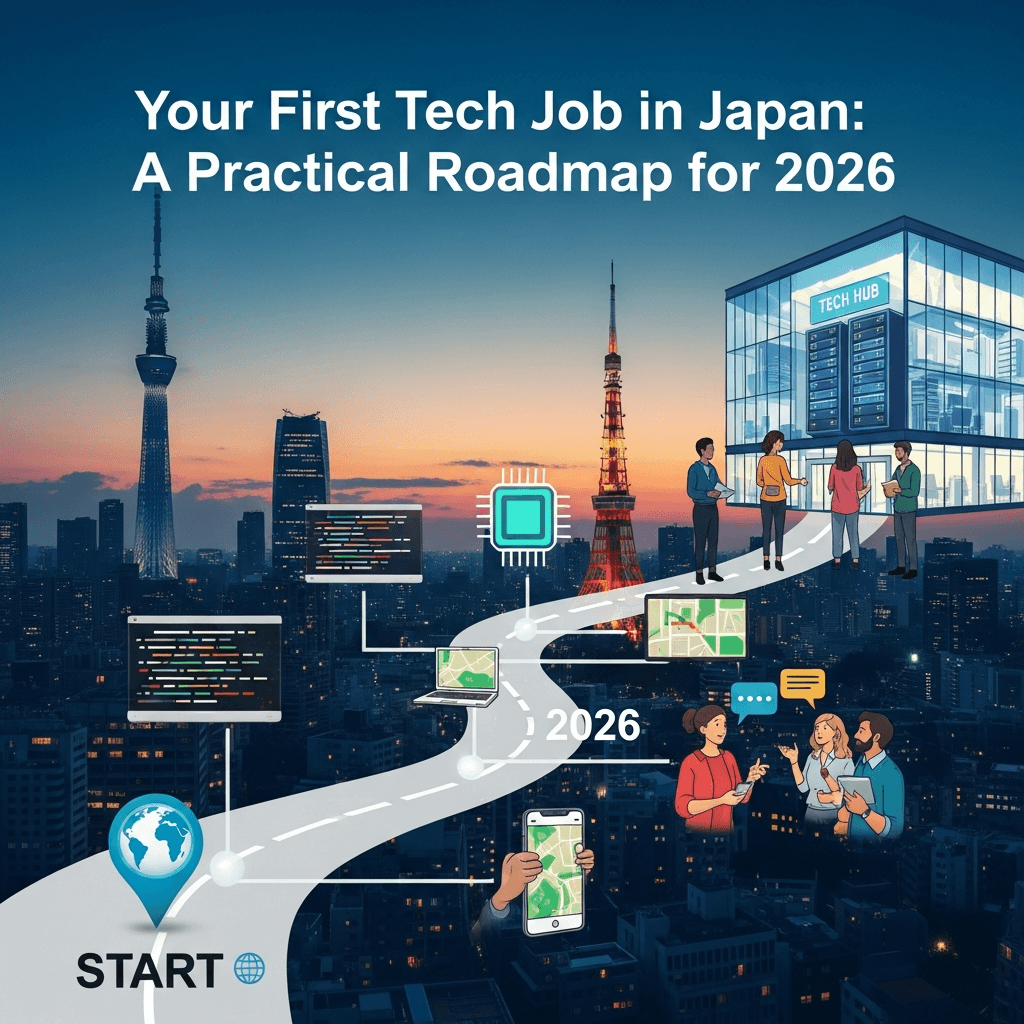
Japan’s tech sector is booming, yet foreign engineers still imagine a maze of paperwork, language barriers, and cryptic hiring rituals. In 2026, that picture is outdated. Remote-first companies, government-led English initiatives, and a desperate talent shortage have flattened many traditional obstacles. What you need now is a clear, time-boxed plan that turns “I’d love to work in Tokyo” into a signed offer letter without wasted motion.
This roadmap is built from 300-plus successful placement stories, recruiter debriefs, and visa data from the Ministry of Justice. Follow it in order, treat each milestone as a non-negotiable deliverable, and you will enter Japan’s tech workforce within twelve months, even if you have zero Japanese today.
1. Market Snapshot: Why 2026 Is a Window of Opportunity
- Talent deficit: Japan projects a shortfall of 790,000 software engineers by 2030 (METI, 2024).
- English-language hiring: 42 percent of Tokyo startups now advertise engineering roles in English, up from 17 percent in 2022 (Japan Startup Survey).
- visa liberalization: The new “J-Find” visa lets graduates from top 100 global universities job-hunt for two years without a sponsor.
- Rising salaries: Median foreign engineer compensation in Tokyo hit ¥8.9 million in 2025, a 21 percent jump since 2022.
Bottom line: if you can ship production code and communicate requirements clearly, Japan wants you.
2. Skill Stack That Gets Hired in Japan (2026 Edition)
2.1 Core Tech Breadth
| Role Focus | Must-Have Stack | Nice-to-Have Proof |
|---|---|---|
| Web/API | TypeScript, Node, Postgres | OpenAPI spec, load-test report |
| Mobile | Kotlin (Android) or Swift (iOS) | Released app with 10k+ downloads |
| Data | Python, SQL, dbt, BigQuery | dbt certification, data-model PR |
| DevOps | Docker, Terraform, GitHub Actions | Cost-savings dashboard |
| AI/ML | Python, PyTorch, HuggingFace | Fine-tuned model on HuggingFace Hub |
2.2 Japanese Proficiency
- N4: Minimum viable politeness for daily life.
- N3: Most domestic companies relax if you reach this before day one.
- N2: Unlocks visa points and management tracks.
Tip: Book the December JLPT now; seats fill in August.
2.3 Business English
Japanese firms with global clients use English stand-ups. Record a two-minute Loom video explaining a recent pull request to show clarity under pressure.
3. Twelve-Month Timeline
| Month | Goal | Deliverable |
|---|---|---|
| 0-1 | Audit skills | Gap matrix vs job posts |
| 2-3 | Build portfolio | Three repos, two blog posts, one talk slide deck |
| 4-5 | Language sprint | N4 vocabulary Anki deck finished |
| 6-7 | Network | 30 LinkedIn connections, 5 coffee chats |
| 8-9 | Apply | 40 tailored applications, track in Airtable |
| 10 | Interview prep | 20 LeetCode mediums, 5 system-design mocks |
| 11 | Offers | 2 written offers, negotiate salary |
| 12 | Relocation | Visa submitted, apartment booked |
4. Where the Jobs Actually Are
4.1 English-Friendly Job Boards
4.2 Recruiter Agencies That Specialize in Foreign Engineers
- Robert Walters – global contracts, strong for finance.
- Zenken Japan – contingency, startup heavy.
- Tokyo Tech Lab – exclusive to foreign engineers, zero Japanese required.
4.3 Hidden Channel: GitHub Issues
Contribute to open-source projects maintained by Japanese companies (Mercari, LINE, MoneyForward). Maintainers often invite contributors to interview.
5. Portfolio That Passes the “So What?” Test
Recruiters skim. Build three artifacts that answer “So what?” in the first five seconds.
- Live URL: Deploy every project on Vercel or AWS. No README-only repos.
- Metrics: “Reduced Docker image size by 68 percent” beats “Wrote Dockerfile.”
- Japanese README: Even basic Japanese shows effort and doubles click-through.
6. Resume and CV: One Page, Two Formats
Prepare both:
- English one-pager: concise bullets, quantified impact, no photo.
- Japanese rirekisho: hand-write with black pen, attach professional photo, use the date of entry Japan style (Reiwa notation).
Keep the content identical; discrepancies raise red flags.
7. Interview Formats You Will Meet
- Online coding (English): 45 minutes, HackerRank or CoderPad.
- System design (mixed): Expect whiteboard in English, but be ready to label database in Japanese.
- Culture fit (Japanese): Prepare a 30-second self-intro (jikoshōkai) ending with yoroshiku onegaishimasu.
- Final “president interview”: Often informal, yet decisive. Bring a physical resume and a small omiyage (local sweets) to signal respect.
8. Salary Negotiation: Numbers That Work in 2026
- New graduate foreign engineer: ¥5.5-6.5 million.
- Mid-level (3 years): ¥7-9 million.
- Senior/lead: ¥10-14 million plus stock.
Ask for:
- Commuter allowance (up to ¥150k/month tax-free).
- Remote work stipend (¥20k/month is common).
- Language school sponsorship (¥300k/year).
Phrase it as: “Given market benchmarks and my contributions, I believe a base of X is fair. Could we explore that range?”
9. Visa Fast-Track: Engineer or Highly Skilled Professional?
- Engineer visa: standard, 5 years max, 4-8 weeks processing.
- Highly Skilled Professional (HSP): point-based, adds 10-year residency path, visa in 2 weeks, spouse can work.
Score 70 points via:
- Master’s degree (20 pts)
- 3+ years experience (5-10 pts)
- JLPT N2 (15 pts)
- Top university (10 pts)
- Age under 30 (15 pts)
Use the Immigration Services Agency online calculator and keep PDF evidence for every point.
10. Relocation Logistics on a Budget
- Apartment: UR Housing requires no key money and accepts foreigners.
- Bank account: Sony Bank or Rakuten Bank open online before arrival.
- Phone: eSIM from IIJmio; keep your home number on Google Voice.
- Furniture: Sayonara sales on Facebook; expect ¥30k for a full apartment set.
Total cash needed for month one: ¥450k including rent deposit.
11. Common Failure Patterns (and How to Dodge Them)
- Waiting for perfect Japanese before applying – companies hire on trajectory, not fluency.
- Spraying 200 generic resumes – Japanese HR values fit over volume; tailor every application.
- Ignoring culture signals – late replies to recruiter emails torpedo trust; answer within 24 hours even if only to confirm receipt.
- Skipping the technical Japanese vocab – learn 100 core words (e.g., 要件定義, 設計書, 単体テスト) to avoid blank stares.
12. Next Actions Checklist (Print and Pin)
- Book December JLPT seat by August 15
- Deploy one TypeScript + Postgres side project by September 30
- Message five Tokyo engineers on LinkedIn this week
- Create Japanese rirekisho template in Word by next weekend
- Set calendar reminder to apply for visa immediately after offer
Tick every box and your first tech job in Japan stops being a dream and becomes a start date on your calendar.
Subscribe to Newletter
Subscribe to Newletter