news
27.01.2026
Understanding Japanese Employment Types in 2026
A clear 2026 guide to Japan’s employment types-seishain, contract, and dispatch-explaining benefits, risks, and how to choose the right path.

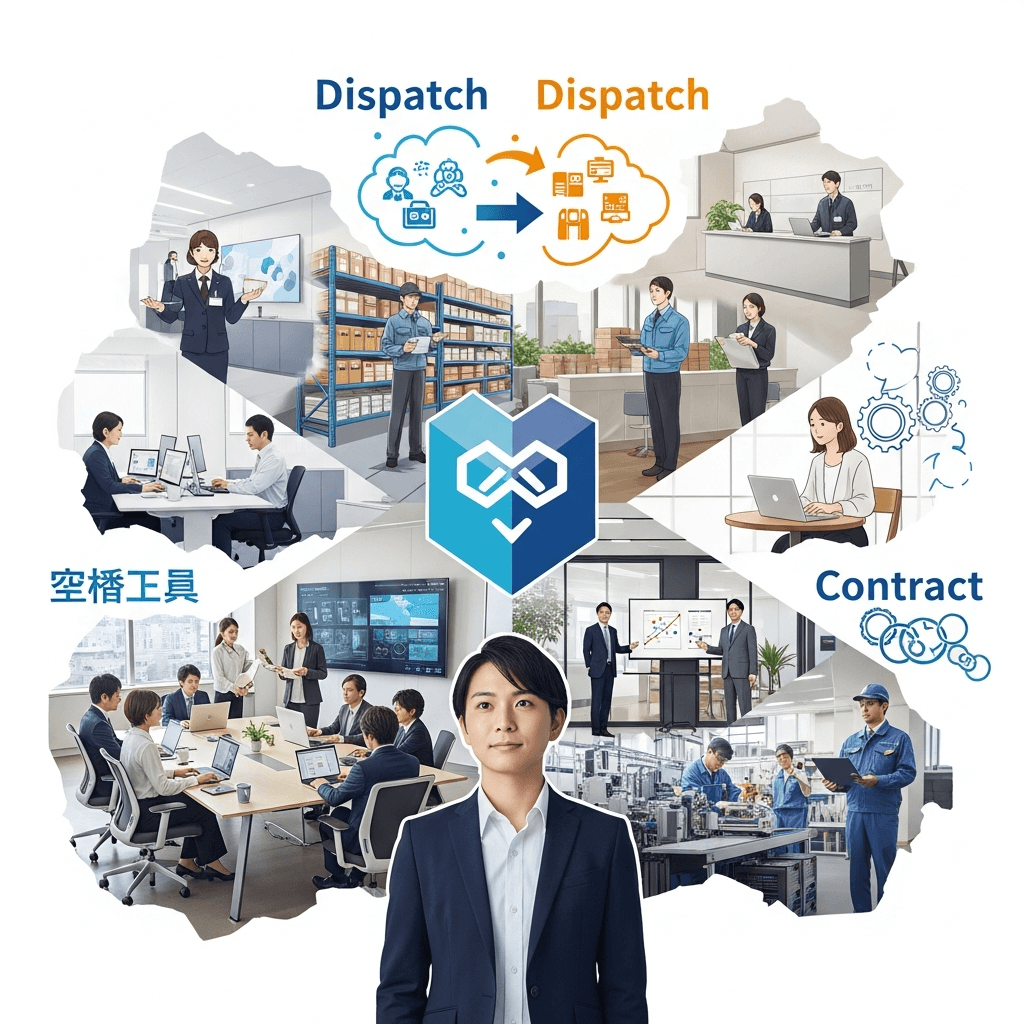
Japan’s labor market in 2026 looks very different from the lifetime-employment model that dominated the late twentieth century. Remote work, AI-driven task matching, and a steadily shrinking workforce have pushed companies to rethink how they hire, retain, and release talent. Yet the legal vocabulary used to describe employment has remained surprisingly stable. The same three umbrella terms—seishain (正社員), keiyaku-sha (契約社員), and haken (派遣)—still appear in every job portal, visa application, and social-insurance form. What has changed are the incentives behind each category, the benefits attached, and the compliance risks for both workers and employers.
This guide walks you through the 2026 landscape, unpacks the fine print, and offers practical criteria for choosing the arrangement that best fits your life stage and career goals.
1. Seishain (Regular Employees) – The Gold Standard with Strings Attached
Legal Definition
Seishain are workers hired under an open-ended employment contract without a predetermined end date. Dismissal must meet the “objectively reasonable and socially acceptable” standard established by Supreme Court precedent.
Statutory Benefits in 2026
- Health & Pension: Employer enrolls you in Shakai Hoken at full 2026 rates (18.3% split 50/50).
- Employment Insurance: 0.9% salary levy provides 80–90% wage replacement for up to 270 days if laid off.
- Retirement Allowance: Roughly one month of base salary per year of service remains the norm among listed firms.
- Severance Notice: Minimum 30 days; 60 days for workers aged 45+ or with 10+ years tenure (2026 amendment).
Hidden Costs
- Overtime: The 2026 overtime cap is 45 hrs/month, 360 hrs/year. Exempt white-collar roles still exist, but companies must now pay a 50% premium for every excess minute.
- Transfers: Mobility clauses are enforceable nationwide unless the move causes “excessive hardship.”
- Side Jobs: Explicit employer consent is no longer required, but you must report outside income that exceeds ¥3 million annually or 20% of base pay.
Who Should Aim for Seishain?
Choose this track if you plan to stay in Japan long term, want to qualify for a mortgage, or need a spousal visa. Banks still treat seishain status as the primary proof of repayment capacity.
2. Keiyaku-sha (Fixed-Term Contract Employees) – Flexibility for Both Sides
Contract Length Rules
- Default Limit: Three years (raised from one year in 2013).
- Expert Exception: Five years if you hold an advanced degree, professional license, or earn above ¥10.75 million per year.
- Renewal Ceiling: After ten years of consecutive renewals, the employer must either convert you to seishain or release you.
2026 Market Reality
More than 38% of the private-sector workforce now falls under some form of fixed-term contract. Tech, gaming, and renewable-energy firms use rolling contracts to staff projects without the severance obligations tied to seishain.
Benefit Gap
- Bonus: Not mandatory. Roughly 55% of keiyaku-sha receive summer/winter bonuses, averaging 2.1 months versus 4.3 months for regular staff.
- Training Budget: Companies with more than 300 employees must spend at least 0.2% of total payroll on contract-worker up-skilling; smaller firms are exempt.
- Pension: You are still enrolled in Shakai Hoken if weekly hours exceed 20 and contract length is ≥ two months.
Negotiation Checklist
- Ask for a shūgyō kisoku (employment handbook) before signing; renewal criteria must be stated explicitly.
- Clarify whether remote work allowances cover utilities and internet.
- Confirm who owns intellectual property created on your own hardware during off-hours.
3. Haken (Dispatched Workers) – Agency Mediation and High Hourly Rates
Regulatory Tweaks in 2026
- Equal Pay for Equal Work: The 2021 mandate is fully phased in. Agencies must disclose wage tables proving parity with the client firm’s direct hires.
- Industry Ban List: Construction, port transport, and medical doctors remain off-limits to haken placement.
- 36-Agreement: Client firms must file an overtime agreement for haken staff just as they do for their own employees.
Typical Use Cases
- Back-Office Overflow: Accounting, HR admin, data entry.
- Seasonal Spikes: Hotel front-desk during sakura and autumn foliage seasons.
- Maternity Cover: One-year dispatch contracts to replace employees on childcare leave.
Earnings Profile
Median hourly wage for office haken in Tokyo reached ¥2,150 in 2026, up 6.8% year on year. Engineering roles command ¥3,200–¥3,800, often beating seishain hourly equivalents once unpaid overtime is factored in.
Downsides
- Career Stagnation: Only 19% of haken workers report receiving formal performance reviews.
- Loan Rejection: Banks classify haken income as “non-regular,” requiring two years of agency-certified payslips for a mortgage.
- Visa Risk: If the dispatch agency loses the client contract, you may be asked to refuse a new assignment and forfeit your visa sponsor.
4. Emerging Hybrid Forms
4.1 Agency-Hired Direct (AHD)
A workaround where the agency hires you as seishain but dispatches you to multiple clients on short stints. You gain Shakai Hoken continuity and severance rights, while clients avoid head-count restrictions.
4.2 Job-Based Employment (ジョブ型正社員)
Introduced by Toyota and Panasonic in 2025, this seishain sub-type ties wages to job grades rather than seniority. Transfers are limited to the same prefecture unless you consent. Expect rapid adoption in 2027 as the aging workforce forces firms to reward productivity over tenure.
4.3 Solo-Worker K.K. (個人合同会社)
A one-person incorporated entity that sells services to one main client. The 2026 tax reform lets you deduct 30% of rent if you declare a home office. Be warned: the pension office may still re-categorize you as de facto employed if you cannot show at least two other revenue sources.
5. Choosing the Right Type – A Decision Matrix
| Factor | Seishain | Keiyaku-sha | Haken |
|---|---|---|---|
| Need a mortgage within 3 yrs | ✅ | ⚠️ (with 2 yrs+ contract) | ❌ |
| Plan to job-hop every 12–18 mo | ❌ | ✅ | ✅ |
| Want max hourly cash | ❌ | ✅ | ✅ |
| Care about paid training | ✅ | ⚠️ | ❌ |
| Prefer location stability | ✅ | ⚠️ | ❌ |
| Need spousal visa points | ✅ | ⚠️ (if 3 yrs+) | ❌ |
Step-by-Step Evaluation
- List non-negotiables: visa, childcare pick-up times, mortgage timeline.
- Map market rates: use the Ministry of Health, Labour and Welfare’s 2026 wage census to benchmark hourly versus annual packages.
- Stress-test: ask “what happens if the client/agency folds?” Ensure you have three months of runway or a secondary sponsor.
- Negotiate in writing: email is enforceable under the 2026 Electronic Contracts Act. Save PDFs of every signed term sheet.
6. Red-Flag Clauses to Reject
- Unlimited overtime consent phrased as “as needed by business.”
- Penalty for early resignation exceeding 20% of monthly salary.
- Non-compete lasting more than one year or covering all of Japan.
- Training bond requiring repayment if you leave within two years.
7. Final Thoughts
Japan’s labor shortage gives workers leverage that did not exist a decade ago, but protections still hinge on contract type. Seishain remains the safest route for long-term residency and borrowing power, yet fixed-term and dispatch roles can yield higher cash flow and faster skill acquisition if you cycle strategically. Whatever path you choose, read every clause, keep digital copies, and budget for at least one career pivot every five years. The employment types may look traditional on paper, but your ability to mix, match, and negotiate will define your 2026 experience in Japan.
Subscribe to Newletter
Subscribe to Newletter